

Страна:
 Россия
Регион:
Почему Топ:
Болота с уникальными экосистемами и торфяными массивами.
Описание:
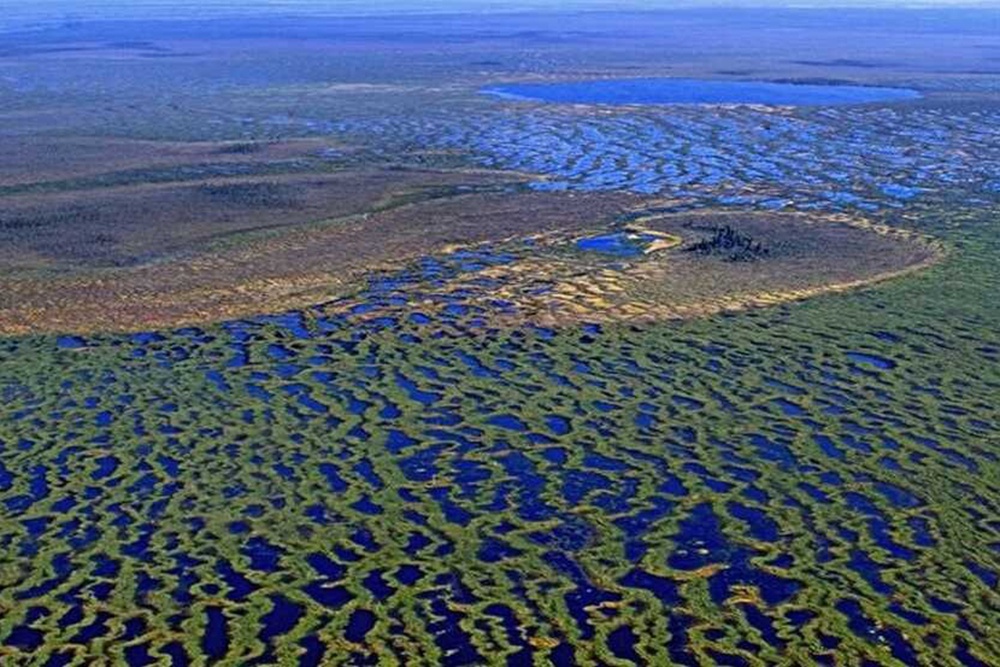
Formed after the last ice age roughly 10 000 years ago, the mire spans over 53 000 km² in Western Siberia and comprises three principal landscape units — raised bogs, transitional mires, and forested mires. Millennia of peat accumulation have built layers up to 10 m deep, dotted with hundreds of thousands of glistening lakes and sparse shrub islands, while a dendritic network of watercourses feeds the major tributaries of the Ob and Irtysh rivers. With virtually no roads or infrastructure, the swamp remains one of the most inaccessible corners of the planet, ideal for studying natural carbon and water cycles and observing rare bird and mammal species.
Другие названия:
Значение:
Время визита:
Цена:
бесплатно
Факты:
Area c. 53 000 km², about 2 % of the world’s peatland, formed from 19 smaller bogs merging over the last 10 000 years, expands by ~ 8 km² annually, holds ~ 400 km³ of fresh water, contains over 800 000 small lakes, site of the last recorded slender-billed curlew, on UNESCO Tentative List.
Значение:
Global; on UNESCO Tentative List and protected as Vasyugansky State Nature Reserve by the Russian Ministry of Natural Resources.
Категории:
Зачем посещать:
Интерес:
Физподготовка:
Лучшее время:
Делать:
kayaking
photography
Eco-tours
scientific expeditions
Доступ:
Дороги:
СОС:
112
Контакты:
Безопасность:
No lifeguards. Hazards include quagmires, sudden weather changes, bear encounters. Crime virtually nonexistent; no known terrorist threat.
Одежда:
Waterproof insulated boots, moisture-proof clothing, layered system for summer and winter.
Климат:
Continental: winter down to –55 °C, summer up to +30 °C; swamps remain perpetually humid.
Советы:
Book tours in advance, bring GPS, insect repellent, warm and waterproof gear.
Связь:
No Wi-Fi. Mobile signal is unstable and entirely absent inside the mire. Satellite phone ensures reliable communication.